- 1457 Jordan Ave, Crofton, MD 21114


Sandtray Therapy In Crofton, MD
What Is Sandtray Therapy?
Sandtray therapy has its origins in “The World Technique,” a type of play therapy developed by British physician and pediatrician Margaret Lowenfeld in the 1920s. Dr. Lowenfeld was frustrated with the limitations of psychoanalytic talk therapy when working with children, so she developed a new, non-verbal therapeutic approach. She provided children with trays of wet and dry sand as well as toys that they could place in the trays to create “worlds.”
In the 1950s, Swiss Jungian analyst Dora Kalff studied with Dr. Lowenfeld and developed what she called sandplay therapy, a Jungian approach to sandtray therapy. Although they represent two different therapies, the terms are often used interchangeably.
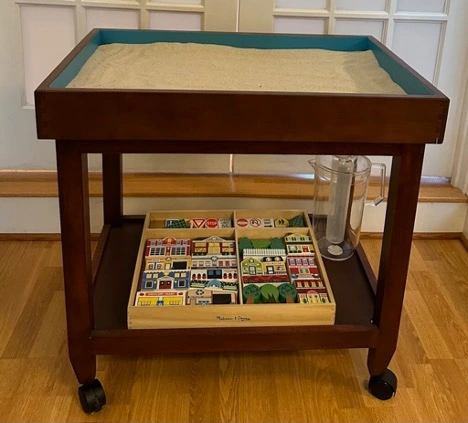
Although sandtray therapy is now available for adolescents and adults in addition to children, the basic idea is the same as in the original “World Technique.” The client chooses objects (referred to as “miniatures”) from the therapist’s collection and arranges them in a tray full of sand. The visual, tactile, and symbolic nature of the sandtray allows the therapist and client to access issues and insights that talk therapy often cannot reach.
What Is Sandtray Therapy Used For?
While sandtray therapy can be used to treat many disorders, it is a particularly effective approach to trauma therapy. It can help a client to get some distance from the trauma and, therefore, feel safer to do the work. Sandtray therapy is also useful when a client is unable or unwilling to talk about what is going on with them, and it can heal preverbal trauma that talk therapy can’t access.
An article on sciencedirect.com cited sixteen randomized controlled trials and seventeen effectiveness studies of sandtray therapy that demonstrated its efficacy in treating a variety of mental health issues, including trauma, generalized anxiety disorder, and substance use disorders, among others[1].
[1] https://www.sciencedirect.com/science/article/abs/pii/S019745561730254X?via%3Dihub
.
How Does Sandtray Therapy Work?
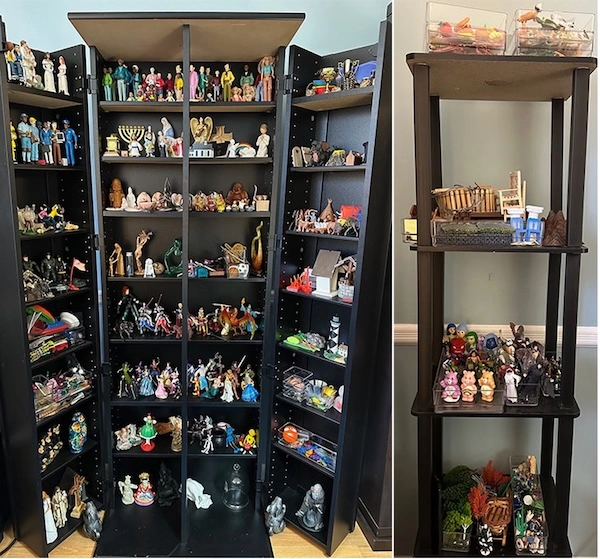
When people see the collection of sandtray miniatures in my office, they sometimes assume that I work with kids. I do not; I work exclusively with adults. I most frequently use the sandtray for trauma work. Trauma comes in many forms, though, and it contributes to many psychological disorders, including depression, anxiety, and substance abuse, among others.
Depending on the goal of a sandtray therapy session, I may give you a prompt to work with, or we may leave things open-ended. You’ll choose miniatures from my collection and arrange them in the sandtray in whatever way strikes you. I’ll invite you to talk about what you’ve created. You may be satisfied with your original sandtray scene, or you may add, subtract, or rearrange miniatures to represent changes. At the end of the session, you can take a photo of the sandtray to revisit later.
What Are The Benefits Of Sandtray Therapy?
Sandtray therapy can feel safer than talk therapy, particularly when you’re processing a traumatic experience. Arranging miniatures in sand often feels a lot less threatening than talking about things you’d rather not even think about. If you’re working on a trauma that happened when you were very young, this play therapy approach will likely work much better than talking would.
I find sandtray therapy and IFS (Internal Family Systems) therapy to be a natural pairing. It can be much easier for you to understand the dynamic relationships among your parts when you can externalize them in the sandtray.
I also use sandtray therapy in combination with EMDR therapy. For instance, you may choose miniatures to represent the EMDR resources we install, or you may create a scene that represents a memory that we’re targeting with EMDR.
It’s often a relief to realize that you can heal from trauma without having to verbalize your experiences. Using the sandtray to imagine alternate versions of events, thoughts, or feelings can make those versions feel real and achievable. Seeing a relationship, a pattern of thinking and behavior, or an event symbolically represented in the sandtray can create a new perspective.
My History With Sandtray Therapy
My first experience of sandtray therapy was in a one-day seminar while I was a graduate student at Loyola University Maryland in the early 2000s. I studied sandtray work on my own and through on-demand trainings for years, then took an in-person 30-hour sandtray training in the fall of 2019.
I became interested in Jungian psychotherapy as a graduate student, and even briefly considered studying to become a Jungian analyst. I have always been drawn to the use of symbol and metaphor, which are prominent themes in Jungian theory; they are also an integral part of sandtray therapy. Also, my inner child loves to play and to collect miniatures! I have long believed in the efficacy of therapeutic techniques that go beyond intellectual approaches to get to the heart of what a client needs in order to heal.