
Jennifer Beall, LCPC, LCADC
Sandtray therapy and EMDR (Eye Movement Desensitization and Reprocessing) are a fabulous pairing.
There are multiple ways my clients and I combine the two. In each case, we use a form of what EMDR calls the BLS (bilateral stimulus), generally the pulsators that we affectionally call “buzzies.”
We can use the sandtray to depict EMDR resources. We can use the sandtray and the buzzies for an EMDR technique called pendulation. Or we can change the scene in the sandtray throughout a session to reflect the changes that happen during EMDR processing.
The sandtray makes our EMDR work concrete.
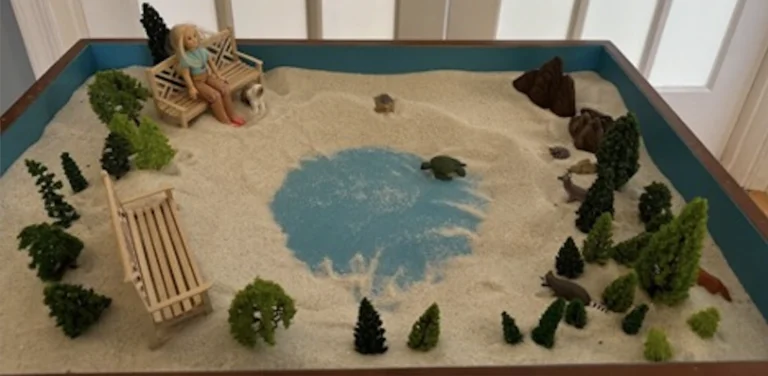
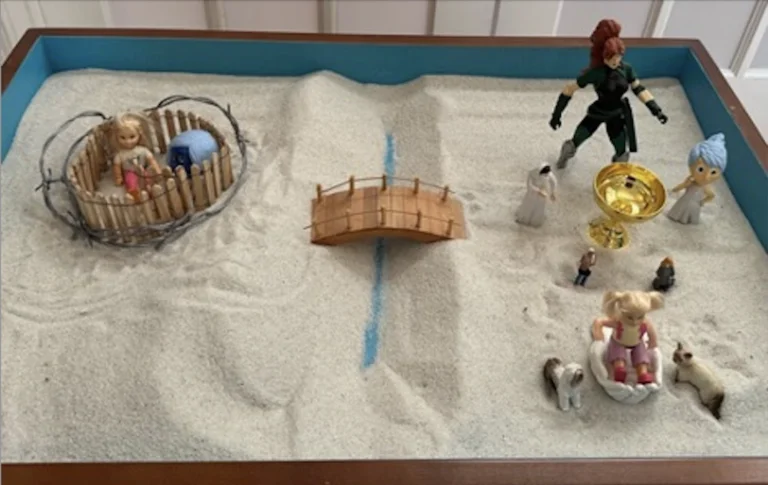
We “install” resources as part of the preparation for EMDR processing. The first resource is a container that the client can use to temporarily store distressing thoughts and feelings[1] The second is a place that the client can visit mentally to feel safe, or calm, or happy, or whatever they need. We also install three attachment resources: a nurturer, a protector, and a wise figure.
One of the helpful characteristics of the sandtray is that it is a container. Whatever the client is working through in sandtray therapy is contained within the bounds of the sandtray. This can create a sense of safety and control.
The client can put the sandtray’s lid on at the end of their session, further containing whatever traumatic material is still present. We can also use EMDR to install an imaginal container that we represent in the sandtray.
We can recreate the client’s safe/calm/happy place in the sandtray, too.
Clients can choose sandtray miniatures to represent their nurturer, their protector, and their wise figure. When the client needs extra support during EMDR processing, they can place one or more of these resources in the sandtray.
We use the sandtray and the EMDR technique of pendulation when working with a particularly distressing trauma. Pendulation consists of going back and forth between a safe scene and a depiction of the trauma that we’re working with. At the beginning, we spend more time with the safe scene than the target scene. Over time, we reverse the process so that we’re spending more and more time with the target scene. Eventually, we can let go of the safe scene and just focus on the target.
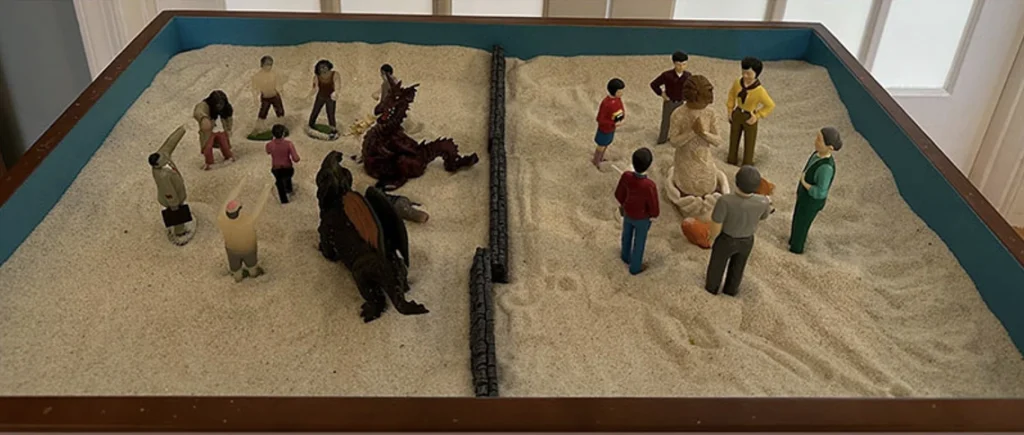
To create the two scenes, we can divide one sandtray in half or use two separate sandtrays. Dividing one sandtray makes it easier to go back and forth, but using two trays allows for more separation of the two scenes. This helps make the safe scene feel even safer.
During EMDR processing, the memory we’re targeting is transformed and/or leads to other thoughts, feelings, and memories. The client can change the scene in the sandtray to reflect these changes. The client and I can take “before and after” photos of the sandtray, and sometimes even take photos each time the scene changes, so the client can remember the work they did in session.
EMDR and sandtray therapy, each powerful in its own right, can be more powerful together. I am one of relatively few therapists with expertise in both modalities. If you’d like to experience this combination for yourself, please fill out a contact form, book a consultation, or call or text me at 410-888-0590.
[1] The container is invaluable for containing unprocessed thoughts and feelings at the end of a session. The client is able to put these thoughts and feelings away and go on with their day without being stuck in the traumatic material. At the beginning of the next session, we can “open” the container and resume work with the material.