
When “Fawn” Isn’t About Bambi

Jennifer Beall, LCPC, LCADC I have a friend that I’ve known since childhood; I’ll call her Jessica. She has an older sister, “Melissa.” Their mother, “May,” was depressed and usually angry when they were growing up, so Jessica and Melissa did what they needed to do to survive her abuse. In my last post, I described three responses to danger: fight, flight, and freeze. There’s also a fourth response, “fawn.” Melissa and Jessica used all four of these strategies. Melissa would sometimes fight by talking back to May. She’d “fly” by going to her room in the basement, where May never went. And sometimes, when May took her into the TV room and closed the door, settling in for a long session of berating her, Melissa would “freeze” by dissociating. Jessica, who was significantly younger than Melissa, didn’t talk back to May until she was a teenager. May didn’t allow her to “fly” by going to her room, so she tried to avoid May’s anger by fading into the woodwork. Jessica’s other main strategy was fawning. She did her best to stay safe by trying to do everything May wanted her to do. She spent a lot of time complimenting May, including calling her the “best mom ever,” in an attempt to stay on her good side. Jessica knew that May, who was a teacher, was capable of being kind to children. May often talked about how much fun she had with her students. Jessica figured that if she could just do the right things, May might like her, too. Like all abusive parents, May was sometimes kind to Melissa and Jessica, which almost made things worse, because they never knew what to expect from her. One minute, she might play a game with them, tapping out the rhythms of songs for them to guess. The next, she might yell at them for not eating something that she’d given them for lunch. Because Jessica never knew what mood May would be in, or what was going to set her off, she constantly walked on eggshells around her. Jessica was hypervigilant because she always felt threatened. Jessica tried to read May’s mind and be what she wanted her to be. It didn’t work, though, because May’s moods were never really about Jessica. They were about what was going on in May’s head. Children’s sense of worth (or lack of it) comes from seeing themselves reflected in their caregivers’ eyes. If May had been mentally healthy, she would have accepted and loved Melissa and Jessica for who they were. That acceptance would have taught them that they were worthy of being loved without having to change themselves. But May was unable to give Melissa and Jessica something she herself had never been given. Melissa and Jessica carried that sense of unworthiness into adulthood. There were plenty of people in their lives who treated them with respect, but they assumed that if those people were able to see who they really were, they wouldn’t like them anymore. After May died, Jessica did what she wished May had done; she entered therapy. Melissa tried therapy for a while, too, but eventually decided that she was just an unhappy person who couldn’t change, so she stopped going. Jessica got a lot of benefit from talk therapy, but it didn’t go deep enough. She still didn’t believe that she deserved to exist. I recommended that she try EMDR, and it worked. She was finally able to truly believe the things she knew intellectually. Maybe you, like Jessica, have benefited from talk therapy, but have found that it doesn’t go deep enough. If that’s true, I invite you to consider EMDR and the other “bottom up” approaches that I offer: Internal Family Systems (IFS) therapy, Brainspotting, and sandtray therapy. If you’re ready to discover which approach(es) fit you best, please fill out a contact form, book a consultation, or call or text me at 410-888-0590.
Survival Strategies In Traumatic Situations

Jennifer Beall, LCPC, LCADC You’ve heard about “fight or flight” responses. An animal, faced with danger, will fight if it can, or run away if fighting is not an option. Fight or flight responses come from the sympathetic nervous system. The sympathetic nervous system is part of the autonomic nervous system (ANS), which controls involuntary processes in the body. The sympathetic nervous system is complemented by the parasympathetic nervous system, which is also part of the ANS. The freeze response, a third response to danger, is a function of the parasympathetic nervous system. If an animal is unable to fight or run away, it might freeze and play dead. Many predators are only interested in live prey and will leave an apparently dead animal alone. (There is a fourth response to danger, “fawn,” that I’ll talk about in my next post.) An essential part of the parasympathetic nervous system is the vagus nerve, which goes from the brain down through most of the vital organs and then back up to the brain. The vagus nerve contributes to the body’s “rest and digest” functions. The vagus nerve is central to polyvagal theory, which was developed by Dr. Stephen Porges. An important aspect of polyvagal theory is neuroception, which is the involuntary and unconscious process of scanning the environment for signs of safety or danger. This includes, among other things, analysis of people’s facial expressions, body movements, and tones of voice. The vagus nerve plays two different roles regarding safety and danger. The ventral vagal system pays attention to safety cues. The dorsal vagal system pays attention to danger cues. People are sometimes in situations where the fight, flight, or freeze instincts are triggered and then immediately resolved, like when encountering a bear while on a hike. More often, though, people experience ongoing stresses that don’t lend themselves to immediate resolution, which can contribute to both mental and physical illnesses. You can imagine what fight or flight might look like in a person’s day to day life. A person might get into a physical (or, more commonly, verbal) fight with someone when they’re under stress. They might “fly” by leaving the room, or maybe by leaving a relationship or a job. Fighting with someone, or leaving a relationship or job, may not be a great idea. If that’s true, and fighting and “flying” aren’t choices a person can reasonably make, stress may build up, with seemingly no available outlet. Then there’s the freeze response. What does it look like for people? While a person might physically freeze in place, it’s more common for the freezing to be internal. This might mean shutting down emotionally. It might be a sense of despair or hopelessness. Or it might be dissociation. These responses to triggers help people to survive traumatic situations, but they’re detrimental long-term. Each person’s life experiences will affect what feels safe or dangerous to them. Traumatic experiences can make situations that feel perfectly safe for one person feel dangerous to another. You never know what might trigger someone’s trauma. I remember, years ago, having a conversation with someone and, to be humorous, pronouncing a particular word as if I were British. The person I was talking to told me that someone with whom they’d had a years-long traumatic relationship pronounced the word that way, so without realizing it, I was triggering them! There are practices that can calm the nervous system of someone who is in fight or flight mode, and exercises that can help someone come out of dorsal vagal shutdown. Therapy can help to resolve trauma that leads to feelings of danger when there is no threat present. If the aftereffects of trauma are interfering with your life, I’d love to help you to heal. You can get in touch with me by filling out a contact form, booking a consultation, or calling or texting me at 410-888-0590.
Brainspotting for Athletes and Creatives

Jennifer Beall, LCPC, LCADC If you’re at all familiar with Brainspotting, you know that it’s a powerful source of healing for trauma, depression, anxiety, addictions, and more. Did you know, though, that Brainspotting can also be used to improve the performance of athletes, artists, actors, writers, and others? When he was an EMDR therapist, Dr. David Grand successfully helped many athletes with anxiety and performance blocks. He discovered Brainspotting while doing EMDR with one such athlete, a skater who was unable to execute a triple loop. As he developed Brainspotting, he found that he had even more success at dealing with these issues with Brainspotting than he had had with EMDR. In his 2013 book Brainspotting: The Revolutionary New Therapy for Rapid and Effective Change, Dr. Grand described his work with Phil, a Division I college catcher. Phil developed what is called “the yips” after being hit in the shoulder by a ball during a game. While he had no trouble with reflexive actions like throwing someone out, he was suddenly unable to throw the ball back to the pitcher after a pitch. Phil went to a sports psychologist who tried to help him by using visualization and relaxation exercises, among other things. It was unsuccessful. A family friend then sent Phil to Dr. Grand for Brainspotting. Dr. Grand was not surprised when, during processing, Phil pictured the moment when he was hit in the shoulder by the ball. The processing didn’t stop there, though. Phil started to process through one injury after another that he had sustained during his athletic career. All of these injuries were physical traumas that accumulated over time. They also caused psychological traumas; the two were intertwined. To fully resolve the issue, Phil also needed to process through two attachment traumas. This was not just true of Phil; there are many athletes whose “sports traumatic stress (STSD)” (in Dr. Grand’s terminology) is partly rooted in childhood attachment traumas. The benefits of Brainspotting don’t stop when the sports trauma is healed. After the trauma has been cleared, the part of the body that was the source of the most activation can be used as a body resource. The therapist and client can then find a Brainspot that corresponds to that body resource and use it for further processing. Even athletes who haven’t experienced traumas like these can benefit from Brainspotting. Every athlete has insecurities and slumps in their performance. Brainspotting’s work in the deeper parts of the brain cuts through and eliminates the negative self-talk associated with these issues. Athletes can also improve their performance by processing on Brainspots that correspond to their strengths. Musicians, actors, writers, and other creatives can also derive these types of benefits from Brainspotting. Like athletes, they can sustain injuries, and the resulting physical and psychological traumas intertwine, as they do with athletes. Just as athletes’ teachers and coaches can be harsh, so can teachers and coaches of creatives. One of the worst things creatives suffer is rejection by auditioners, directors, audiences, and others. Creatives tend to be very sensitive and perceive the world differently than other people do. Parents, teachers, and peers often don’t understand them, and frequently give them a hard time. This wounds a deep, essential part of them, and can also create anxiety and performance blocks. Many people think that trauma is the source of their creativity; they are afraid that healing the trauma will rob them of creativity. This is not true. Trauma actually decreases access to creativity, and healing restores a person’s creative potential. Dr. Grand frequently says that “There is no healing without creativity, and there is no creativity without healing.” Did this post teach you anything new about what Brainspotting can do? Where are the areas that you can imagine it helping you? When you’re ready to discuss the potential of Brainspotting to improve your life, fill out a contact form, book a consultation, or call or text me at 410-888-0590.
Sandtray Therapy and EMDR: A Powerful Pairing

Jennifer Beall, LCPC, LCADC Sandtray therapy and EMDR (Eye Movement Desensitization and Reprocessing) are a fabulous pairing. There are multiple ways my clients and I combine the two. In each case, we use a form of what EMDR calls the BLS (bilateral stimulus), generally the pulsators that we affectionally call “buzzies.” We can use the sandtray to depict EMDR resources. We can use the sandtray and the buzzies for an EMDR technique called pendulation. Or we can change the scene in the sandtray throughout a session to reflect the changes that happen during EMDR processing. The sandtray makes our EMDR work concrete. We “install” resources as part of the preparation for EMDR processing. The first resource is a container that the client can use to temporarily store distressing thoughts and feelings[1] The second is a place that the client can visit mentally to feel safe, or calm, or happy, or whatever they need. We also install three attachment resources: a nurturer, a protector, and a wise figure. One of the helpful characteristics of the sandtray is that it is a container. Whatever the client is working through in sandtray therapy is contained within the bounds of the sandtray. This can create a sense of safety and control. The client can put the sandtray’s lid on at the end of their session, further containing whatever traumatic material is still present. We can also use EMDR to install an imaginal container that we represent in the sandtray. We can recreate the client’s safe/calm/happy place in the sandtray, too. Clients can choose sandtray miniatures to represent their nurturer, their protector, and their wise figure. When the client needs extra support during EMDR processing, they can place one or more of these resources in the sandtray. We use the sandtray and the EMDR technique of pendulation when working with a particularly distressing trauma. Pendulation consists of going back and forth between a safe scene and a depiction of the trauma that we’re working with. At the beginning, we spend more time with the safe scene than the target scene. Over time, we reverse the process so that we’re spending more and more time with the target scene. Eventually, we can let go of the safe scene and just focus on the target. To create the two scenes, we can divide one sandtray in half or use two separate sandtrays. Dividing one sandtray makes it easier to go back and forth, but using two trays allows for more separation of the two scenes. This helps make the safe scene feel even safer. During EMDR processing, the memory we’re targeting is transformed and/or leads to other thoughts, feelings, and memories. The client can change the scene in the sandtray to reflect these changes. The client and I can take “before and after” photos of the sandtray, and sometimes even take photos each time the scene changes, so the client can remember the work they did in session. EMDR and sandtray therapy, each powerful in its own right, can be more powerful together. I am one of relatively few therapists with expertise in both modalities. If you’d like to experience this combination for yourself, please fill out a contact form, book a consultation, or call or text me at 410-888-0590. [1] The container is invaluable for containing unprocessed thoughts and feelings at the end of a session. The client is able to put these thoughts and feelings away and go on with their day without being stuck in the traumatic material. At the beginning of the next session, we can “open” the container and resume work with the material.
Are You Fiercely Independent?

Jennifer Beall, LCPC, LCADC Growing up, many people learned to be “fiercely independent,” never asking for help, and always hiding their feelings so they could appear strong. How well does that work? I’m not sure where the phrase “fiercely independent” originated, but lots of people lay claim to this quality. What’s not to like, really? If you don’t depend on anyone else, they can’t let you down. Think of the possible negatives that might come from asking for help. For one thing, you might be rejected. And if someone helps you, not only might you feel like you’re in the “one down” position, but you’ll probably feel like you owe them. Nobody likes to be indebted to someone else. And yet…fiercely independent people might get kind of lonely. Humans are pack animals, after all. It’s true that there’s some degree of vulnerability in being in relationship with others, but it has its advantages, too. And guess what? It turns out that asking for help can actually be good for you! Angela Duckworth, in an opinion piece for the New York Times[i], offers evidence of some of its benefits. College students who ask others for help perform better than those who don’t. Entrepreneurs are more successful when they learn from one another. People who have networks of support tend to have better mental health overall than those without them. Now let’s look at the practice of hiding feelings. When I was a kid, I loved singing along with Melissa Manchester’s song “Don’t Cry Out Loud,” which could easily have been the anthem of all of those who considered themselves to be fiercely independent. Here’s the chorus: “Don’t cry out loud/ Just keep it inside/ And learn how to hide your feelings/ Fly high and proud/ And if you should fall/ Remember you almost had it all.” Many people have been raised to believe that they should try to avoid feeling one or more of what are often called the “negative” emotions, like anger, sadness, and fear.[ii] If, by some chance, someone does accidentally experience one of these emotions in the presence of someone else who disapproves of them (spoiler alert: everyone experiences all of these feelings), the last thing they want to do is let them know about it! Think of action movies, the ones with lots of danger and explosions. The heroes of these movies are seen as courageous. It’s true that putting yourself into hazardous situations can be a sign of courage. But there’s another kind of courage that isn’t nearly so popular: the courage to be vulnerable enough to show your emotions. This doesn’t seem to make sense. What do courage and vulnerability have to do with each other? Think about it, though. In a society that discourages vulnerability, being willing to open up to someone and show them your feelings takes a great deal of courage. Many people who have been discouraged from showing their emotions eventually find themselves unable to identify what they’re feeling. This is different, of course, from not having feelings at all. They definitely still have them, but they have put them in the “irrelevant” box long enough that they no longer recognize them. This can be dangerous, because only by recognizing and allowing your feelings can you hope to regulate them. Burying them doesn’t work, because they’re going to come out one way or another. It’s like burying drums of toxic waste underground. Eventually, the drums are going to corrode, start to leak, and poison the ground around them without anyone realizing it. What do you think? Have I made a case for being less fierce in your independence? Are you willing to consider that asking for help and sharing your feelings might be good things? If so, a great first step would be to fill out a contact form, book a consultation, or call or text me at 410-888-0590. [i] https://www.nytimes.com/2026/08/28/opinion/successful-people-help.html?unlocked_article_code=1.CFE.bgSy.UW3W90wJGD5A&smid=url-share [ii] The emotions that are discouraged are often dictated by gender. For instance, women and girls are often discouraged from showing anger, while men and boys are often discouraged from showing sadness.
How Might The Serenity Prayer Guide You Today?

Jennifer Beall, LCPC, LCADC God, grant me the serenity to accept the things I cannot change The courage to change the things I can And the wisdom to know the difference. Invaluable guidance packed into three little lines. The Serenity Prayer, as it’s usually called, is said to have been written by Reinhold Niebuhr, a Protestant theologian, in the 1930s. In the early 1940s, the 12-step group Alcoholics Anonymous (AA) began using it in meetings. These days, it’s recited at the beginning and/or end of most AA meetings. Let’s start by addressing the “prayer” aspect of the Serenity Prayer. Just as there are those people who don’t want to join AA because of the centrality of a “higher power” in AA philosophy, there are people who might avoid the Serenity Prayer because they are atheists or agnostics. These lines don’t have to be a prayer, though. You can take “God” out and call it the Serenity Poem, or something entirely different, if you want to. The important thing is that it’s a helpful summation of a principle that offers guidance for pretty much any area of life. Just as the Serenity Prayer can exist without referring to God, it can exist without Alcoholics Anonymous. Many people learn it through AA and other 12-step groups, but it’s not exclusive to those groups. This prayer is one of many pieces of wisdom promoted by AA that anyone can apply to their own lives, whether they’re an alcoholic/ addict/ codependent/ Adult Child of an Alcoholic or not. Let’s look at the first line of the prayer again: “God, grant me the serenity to accept the things I cannot change…” I’m pretty sure I’ve never met a person who had problems with alcohol who didn’t also have control issues. My idea of “control issues” is different than what many people think of, though. When I think about someone having control issues, I don’t picture an evil puppet master pulling people’s strings. Instead, I picture someone whose life has felt out of control for as long as they can remember; they’re just trying to find safety and personal agency. Problematic drinking often begins as an attempt to control or cope with something like anxiety, stress, traumatic memories, or relationship problems. It’s only a temporary fix, though, because drinking just kicks the can down the road; at some point, a person has to stop drinking. When they do, they realize that the original problem is still there, but now they have a drinking problem on top of it. It’s ironic that people drink to gain control, and then drinking takes control away from them. The most frequent targets of control issues are other people. Some members of AA add a couple of words to the Serenity Prayer to address this. This is their version: God, grant me the serenity to accept the things I cannot change (YOU) The courage to change the things I can (ME) And the wisdom to know the difference. That’s the essence of the Serenity Prayer. There are many things in life that you can’t control. The thoughts, feelings, and actions of other people are among those. But you can practice changing things that are within your control, particularly your own thoughts, feelings, and actions. What are the things you’ve tried to control or change in your life? How many times have you been successful, and how many times have you fallen short? If you’ve been trying unsuccessfully to change your relationship with alcohol, it’s probably at least partly because you’re trying to do it on your own. If you’re ready for a partner on your road to change, fill out a contact form, book a consultation, or text or call me at 410-888-0590.
Letting Go of Worries
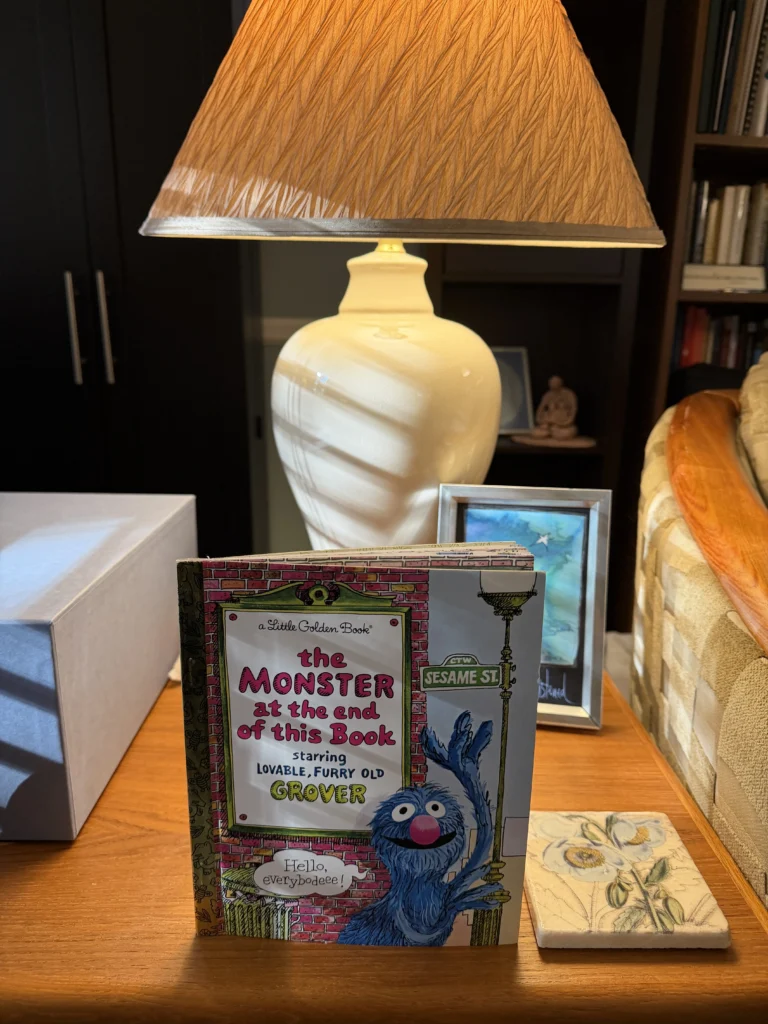
Jennifer Beall, LCPC, LCADC I keep a copy of The Monster at the End of This Book on display in my office. It’s a classic, it was one of my childhood favorites, and it makes an important point about anxiety. The premise is simple: loveable, furry old Grover learns that there’s a monster at the end of the book, and he’s afraid. He begs the reader not to turn the pages, because each page turned gets closer to the monster. He ties the pages together, nails them together, and, finally, builds a brick wall, all in an attempt to keep the reader from getting to the end of the book. Of course, his attempts are unsuccessful. Before he knows it, he arrives at the end of the book only to find, to his embarrassment, that HE is the monster! He had nothing to be afraid of after all. This lesson isn’t just for kids; it’s relevant for adults, too. Often, the objects of our worries aren’t the real problem; the real problem comes from the limitations the worries put on us. Grover’s fear was resolved in the space of a dozen or so pages. While it’s not usually that simple in real life, specific worries like “I’m going to fail the exam” or “I’m not going to get the job” might be easily dismissed once the person has passed the exam or gotten the job. Or the person doesn’t pass the exam or get the job, but they find a way to be ok anyway. Worries about concrete events are not so easily resolved, though, if they’re part of a larger pattern. And sometimes people have vague worries that aren’t easy to challenge because they don’t examine them closely enough to do so. Melissa Kirsch, a writer for the New York Times, writes a column called “The Good List.” On June 17, 2026 she wrote about worrying, and the “what ifs” that are part of it. There are lots of possible “what ifs”, like “What if I ask someone out and they reject me?” or “What if there’s a huge rainstorm and my basement gets flooded?” In the column, Kirsch says that she taped a note to a kitchen cabinet that reads “What if it all works out?” It’s a reminder that positive outcomes are also possible, and they may be as likely as the feared outcomes. In any case, reading the note temporarily interrupts the flow of negativity and offers a chance to consider other possibilities. A therapist employing cognitive behavioral therapy (CBT) will likely use various techniques to challenge a client’s worries. For instance, they might recommend that the client do what Melissa Kirsch does: think of possible outcomes other than the disaster they’re expecting, then evaluate the relative likelihood of the positive, negative, and neutral outcomes. The therapist might also invite the client to mentally step back and imagine that the thing they’re worried about has already happened, then picture what the results might be. If a client does this, they’re likely to realize that they could handle it if their worry was realized. As always, though, CBT has its limitations. The logical analysis of the possibilities can be invaluable in helping a client to dismiss their worries, but if there’s an underlying pattern, it’s likely that CBT will not be enough to change it. In this case, “bottom up” approaches like Internal Family Systems (IFS), Eye Movement Desensitization and Reprocessing (EMDR), Brainspotting, and sandtray therapy are much more likely to work. Like Grover, you may have tried a variety of things, including building mental walls, to keep your worries at bay. And, also like Grover, you’ve probably realized that those approaches don’t work long-term. If you’re tired of worries taking over your life, I’d love to discuss how I can help you to reclaim your peace of mind. To get in touch, please fill out a contact form, book a consultation, or call or text me at 410-888-0590.
Does It Matter How EMDR Works?

Jennifer Beall, LCPC, LCADC EMDR (Eye Movement Desensitization and Reprocessing) is an evidence-based therapy that has been shown to be effective in treating PTSD, depression, anxiety, addictions, OCD, and chronic pain. It has been officially recognized by the U.S. Department of Veterans Affairs, the American Psychological Association (APA), and the World Health Organization (WHO).[i] But how does it work? There are still many mysteries about the brain, so it’s not terribly surprising that researchers have yet to determine exactly how EMDR helps people to heal. I remember, years ago when I was newly trained in EMDR, going to a session at a conference of the EMDR International Association (EMDRIA) where a neuropsychologist explained the latest research on the brain mechanisms of EMDR. I’m an intelligent person, but I’m not a neuropsychologist, and I felt like one of the kids in a Peanuts cartoon listening to an adult talk: “Wah wah wah, wah wah wah…” Needless to say, I didn’t come away from that session with a thorough understanding of the brain science behind EMDR. When I became an EMDR therapist, one of the prevailing theories about the workings of EMDR was that it triggered something akin to the process of REM (rapid eye movement) sleep. This made sense, because EMDR and REM sleep have similar goals—processing memories and filing them away where they belong. In the original version of EMDR, which is still commonly used, the therapist moves two fingers back and forth while the client follows the movement with their eyes. The eye movements associated with this form of bilateral stimulus (BLS) seem to mimic the eye movements associated with REM sleep. Interestingly, though, even when the BLS is achieved by using pulsators (“paddles” held in clients’ hands that vibrate alternately), clients’ eyes often move back and forth on their own. A more recent theory of the mechanism of EMDR, by Ad de Jongh and Suzy Matthijssen[ii], has to do with working memory. The idea is that we only have so much working memory capacity, and it’s hard to do two things at the same time. The therapist asks the client to do something that taxes the working memory while also holding in their minds the trauma they’re working on. Because of the limits of working memory, the client’s brain is unable to hold on to the feelings associated with the trauma, and those feelings are released. When I explain EMDR to clients, I don’t attempt to recreate that neuropsychologist’s lecture from years ago. I tell them that the brain effects of EMDR are still being studied. I share the REM sleep theory and the working memory theory. And then I tell them some version of what David Grand, the developer of Brainspotting therapy (which I often describe as “EMDR-adjacent,” because the two therapies work similarly) said about the subject. He said (of Brainspotting), “You don’t have to know what it is, to know that it is.” My clients have had various reactions to the unusual nature of EMDR therapy. Some clients, after having experienced its profound healing benefits, are annoyed that something that doesn’t make sense to them is nevertheless so effective. Others, including people who make a living from understanding how things work, are able to appreciate EMDR’s transformative effects even if they’re not fully explained. In the end, how much does it matter how EMDR works? Each person has to make their own decision about that. No matter where you stand on the question, though, I would love to help you to experience EMDR’s amazing healing effects. If you’re interested in learning what EMDR can do for you, please fill out a contact form, book a consultation, or call or text me at 410-888-0590. [i] https://www.emdria.org/about-emdr-therapy/ [ii] https://www.enhancingtraumatreatment.com
You Were Not Responsible for the Trauma You Experienced

Jennifer Beall, LCPC, LCADC Many trauma survivors could identify with Jean-Luc Picard, captain of the USS Enterprise, in the following dialogue from the Star Trek: The Next Generation episode titled “Family.” In this episode, Jean-Luc is visiting his brother, Robert, not long after having been rescued from the Borg, a race of cyborgs who had kidnapped him and made him one of them. Robert: You have been terribly hard on yourself. Jean-Luc: You don’t know, damn it, you don’t know. They took everything I was. They used me to kill and to destroy and I couldn’t stop them. I should have been able to stop them! I tried. I tried so hard, but I wasn’t strong enough! I wasn’t good enough! I should have been able to stop them! As human beings, we want to believe that we’re in control of what happens to us. It follows, then, that if someone is traumatized, they might come to believe, consciously or unconsciously, that if they had done something differently, they could have changed or prevented what happened. This is even more true when a child experiences trauma, because children believe that everything that happens in their world happens because of them. It doesn’t matter that they had little or no power or agency; they still think that they caused what happened to them, and that if they could have figured out the magic words, or actions, or whatever, they could have fixed things and saved themselves. Not only do people who have experienced trauma tend to believe they should have rescued themselves; if they also witnessed other people being traumatized, there’s a good chance that they believe they should have saved those other people, too. IFS (Internal Family Systems) therapy teaches us that every person is made up of many parts. People who have experienced trauma have parts who are capable of understanding that, logically, it doesn’t make sense to feel responsible for traumas that they were unable to prevent or stop. If I were working with one of these logical parts of a client, I would suggest that they imagine someone in the same position they were in when the trauma happened, then decide whether that person could reasonably be expected to stop the trauma. If they were a child when the trauma happened, I would invite them to observe a child of the same age they were, then ask themselves if they would expect that child to get out of the situation on their own. If they had kids, I would ask them to imagine expecting that of their child(ren). Put that way, it’s easy to see that a person who was traumatized was not, in fact, responsible for what happened. But that only helps the logical part; it doesn’t convince the traumatized part. I became an EMDR therapist years ago because I wasn’t satisfied with the level of healing that cognitive behavioral therapy (CBT) made possible. CBT helped my clients to logically understand that they deserved to exist, that they were worthy of love, that they were enough, and that their needs weren’t too much. The problem was that they still didn’t truly believe those things. The logic couldn’t touch the parts of their brains where the trauma was stored. CBT takes a top-down approach. My therapeutic specialties (EMDR, IFS, Brainspotting, and sandtray therapy), on the other hand, are bottom-up approaches. Bottom-up approaches make true healing possible because all parts of the brain, not just the prefrontal cortex, get the memo. If reading the dialogue at the beginning of this post touched you, I’d love to help you to finally understand, really and truly, that you were not responsible for what happened to you. If you would like to experience this kind of healing, please fill out a contact form, book a consultation, or call or text me at 410-888-0590.
Using Sandtray Miniatures To Work With IFS Parts

Jennifer Beall, LCPC, LCADC Sandtray therapy and IFS (Internal Family Systems) therapy are a natural pairing. My clients and I often use the sandtray to concretize and get to know the parts we’re working with, to make a parts map, and to show the relationships between parts. All people have many parts. There are exiles (hurt parts, usually very young) and two types of protectors (managers and firefighters). All of these parts interact as if they were part of a (very large) family. When my clients and I do IFS therapy, we generally start by choosing a part to focus on. If we could just deal with that one part without any other parts showing up, it would be relatively straightforward. That’s not usually how it happens, though. It’s quite common for other parts to jump in during the course of the session. This can get very confusing, which is why the sandtray comes in handy. Not only can you represent all of your parts in the sandtray so you don’t lose track of them; you can also show their relationships to each other and move them around to show ways in which their relationships change. Let’s start with choosing miniatures to represent parts. You might choose miniatures that have clear associations with certain emotions or character traits. For instance, you might choose a character from the Inside Out movies to represent an emotion. You might choose a character from books, movies, or TV, like someone from Star Wars, Harry Potter, or Winnie the Pooh. Or you might decide to select something metaphorical, like a black sheep. Miniatures don’t have to represent something that’s widely known, though, to have significance. Your unique experiences have created associations that are specific to you. In fact, I often find that selections that have special meaning for the client are the best choices. It’s likely that a part will feel more seen and valued if the miniature chosen to represent them is personal in this way. What kinds of miniatures do people generally select to represent exiles, managers, and firefighters? Clients frequently choose young children or babies to represent exiled parts. Managers, which are proactive protectors who try to stop problems before they start, might be represented by miniatures that are associated with responsible or professional roles. A firefighter part, which is a reactive protector who steps in when managers’ efforts aren’t sufficient, could be literally represented by a firefighter. More often, though, clients will choose miniatures that represent firefighter behaviors, like raging at other people, dissociation, or addictive behaviors. Sandtray work, of course, isn’t just about the identities of individual miniatures; it’s about the placement of the miniatures and their relationships to others. A trapped exile might be in a cage. A protector might stand between an exile and a possible threat, or they might put a barrier around the exile to keep them safe. Polarized parts might physically be set in opposition to each other. Sandtray scenes don’t have to be static; changes in relationships or circumstances are often represented by rearranging miniatures. The door to the cage might open and free the exile. Something that was originally seen as a threat might turn out not to be a problem after all. And polarized parts can find bridges that help them to connect with each other. If you and I use the sandtray to work with parts, I’ll encourage you to photograph your sandtrays at the end of each session. That way, you can revisit the parts we worked with in between sessions and, over time, compile an album of photos that make up your parts map. To experience sandtray parts mapping for yourself, fill out a contact form, book a consultation, or call or text me at 410-888-0590.