
If It Doesn’t Have Your Name On It, Don’t Pick It Up

Jennifer Beall, LCPC, LCADC These are wise words from Codependents Anonymous (CoDA), and a helpful reminder not to take on responsibility that doesn’t belong to you. Like a lot of great advice, though, it is often easier said than done. What happens if you didn’t pick up something (like emotional responsibility for a parent) voluntarily, or even knowingly? What if it was handed to you before you were born? What if it was actually handed down through your family for generations? I’ve worked with many clients over the years who were negatively affected by familial patterns when they were growing up. With very few exceptions, these negative effects weren’t intentional. My clients’ parents/caregivers simply didn’t know any other way to be; they were just following the examples set by their parents, and probably their parents’ parents. It can be easy to assume that you had no reason to be unhappy with your childhood if you had a roof over your head, clothes to wear, and food to eat, especially if one or both of your parents had it harder than you did. You might worry that the emotional pain you feel isn’t legitimate. You might also worry that admitting you carry pain from childhood means that you’re blaming your parents. Actually, there is no need to assign blame. Two things can be true at the same time: your parents did the best they could with what they had, and you did not get what you needed from them. There’s a good chance that at least part of the trauma you’re dealing with is generational trauma; it didn’t start with you, or even with your parents, but was handed down through multiple generations.[i] One way that generational trauma can be handed down is through learned behaviors. For instance, if one of your grandparents had a serious car accident, it might have made them a nervous driver. That nervousness might have been passed down to one of your parents, and then to you. Trauma isn’t just handed down through behaviors, though. It can also be passed down through genes. Epigenetics is the study of changes in the ways that genes are expressed. Aspects of the physical environment can create epigenetic changes, but traumatic experiences can, too. There is evidence to suggest that trauma-induced epigenetic changes can be passed on from parents to children.[ii] Luckily, the therapeutic techniques I prefer (Internal Family Systems, EMDR, Brainspotting, and sandtray therapy) don’t just heal trauma that occurred in your lifetime; they can also heal generational trauma. An example of this is what Internal Family Systems (IFS) therapy calls “legacy unburdening.” If you’re doing a legacy unburdening, you hand the burdens of inherited trauma back through the generations of your family; the family member who is the farthest back releases the burden. They then take in a positive quality to replace it, and hand that down the line, from one person to the next, until it gets to you. If you’re thinking that sounds really woo-woo, I get it. It sounded that way to me, too, until I experienced a legacy unburdening of my own and realized what a powerful healing process it can be. If you picked up an unhelpful pattern of thinking, feeling, or behaving without realizing it, or if it was handed to you before you were old enough to even have a choice, I can help you to put it down. If you’re ready to let go of things that shouldn’t have been yours in the first place, fill out a contact form, book a consultation, or call or text me at 410-888-0590. [i] https://health.clevelandclinic.org/generational-trauma [ii] Cooper, A. (June 12, 2024). “Can trauma be inherited through genes?” National Geographic. https://apple.news/Ajp_cp-ySQ96H_u6lVnbw8g
You Were Not Born Codependent

Jennifer Beall, LCPC, LCADC Think about the last time that someone important to you was upset and you didn’t know why. How did you react? Did you express sympathy and offer them support, if appropriate, without being drawn into the feelings yourself? Maybe, instead, you found yourself wondering if you did (or didn’t do) something that made them upset, even if there was no evidence to support that idea. If your first instinct was to take responsibility for their feelings, you may be codependent. And if you are codependent, you probably learned that coping mechanism when you were a very young child. Young children are narcissistic by nature; they believe that they are the cause of everything that happens in their world. Therefore, if one of their caregivers is upset, they believe it is their fault. And they assume that if they are responsible for their caregivers’ feelings, they must also be able to change those feelings; they just have to figure out what they’re doing wrong so they can fix it. If a parent is an alcoholic or has something else going on that makes them unable to adequately meet their child’s needs, an unhealthy dynamic develops. The child knows when their parent is unhappy and assumes it’s their fault. The parent is unable or unwilling to take appropriate responsibility for their own feelings and actions, thus directly or indirectly supporting the child’s belief that they, not the parent, are the source of whatever is going on. This is the heart of codependency. Someone who grows up in this sort of family often develops the belief that it’s their job to take responsibility for the thoughts, feelings, and actions of other people. Because this pattern develops in childhood, their unconscious assumption is that if they take responsibility for the other person in a relationship, that person will, in turn, take care of them, as their caregivers should have done when they were kids. A codependent person might be labeled a people pleaser and told that they have control issues. They may be accused of being manipulative. A codependent person who tries to control and manipulate others isn’t generally an evil puppet master trying to pull other people’s strings, though; they’re trying to keep themselves safe. As a child, they learned to try to manipulate their parents into taking care of them so that they would survive. People who are codependent don’t learn effective ways of being in relationship and handling emotions because they don’t see those things being modeled by their parents. They may become aware, at some point, that there are healthier ways to interact with other people than the ones they learned, but it might not even occur to them to try to learn those approaches themselves. They’ve only known one way of being in the world, and they probably assume that it’s just how they were made. And if that’s true, they might not see a point to trying to change. The truth is that no one is born codependent, and things that can be learned can also be unlearned. If you are codependent, I can help you to develop more effective ways of being in relationship with others. If that would be of interest to you, please fill out a contact form, book a consultation, or call or text me at 410-888-0590.
All Parts Are Welcome With IFS

Jennifer Beall, LCPC, LCADC Take a moment to consider some of the aspects of yourself that you don’t like. For instance, you may be very critical of yourself. Perhaps you bend over backwards to make everyone else happy. Maybe you tend to fade into the woodwork so as not to call attention to yourself. Have you ever wished you could get rid of those parts of yourself? Many people think that we need to banish thoughts and behaviors that aren’t serving us. They don’t know that everyone has many parts, and these ways of thinking and acting are roles that parts take on in a sincere but misguided attempt to help us. In most cases, the roles these parts take on are developed when we are very young. When we’re that young, we have few resources, very little power, and a very basic (often incorrect) understanding of the world. When we encounter situations that feel scary or dangerous to us, we face them with limited toolkits, but we manage to find coping mechanisms to get us through. In IFS terms, this process involves two different types of parts. Exiles are vulnerable, wounded parts. Protectors are parts that try to protect exiles or, in some cases, try to protect the system as a whole from exiles (if they think the exiles might overwhelm the system). The problem is that the protectors are essentially only moments older than the exiles, because when one part feels threatened, another part immediately takes on the role of its protector. Picture an exile and a protector as a pair of young twins. Imagine one twin is getting yelled at by their mother, and her sister (who is a few minutes older than she is) jumps in between them and tries to protect her. Maybe this works temporarily, possibly by distracting their mother. From that moment on, the older twin takes on a protector role; she believes it’s her job to keep her sister (the exile) safe. This is the dynamic that is created when one internal part decides that it’s their job to protect another part. It’s one thing to use the unsophisticated forms of protection that we develop as children when we’re, say, four years old. It’s quite another thing to still be using them when we’re 24, or 44, or 64. And yet, that’s what people do if they don’t learn other ways to deal with difficult situations. Maybe you’re thinking that if these protector parts are so unsophisticated and ineffective, it does make sense to banish them. Think back to the pair of twins, though. Would you banish the older twin because she wasn’t qualified to protect her sister? Of course not! A better option would be for a caring adult to let the older twin know that she doesn’t have to keep her sister safe, because the adult will do it. The adult and child can work together to find something more age-appropriate for her to do, like play a game with her little sister. What kinds of situations might lead to the development of the defense mechanisms I mentioned at the beginning of this post? A self-critical voice might arise if a part of you thinks it would hurt less if you criticized yourself before someone else could do it. Or it might be an attempt to motivate you to do everything perfectly so that bad things won’t happen to you. People pleasing is a very common coping mechanism. It’s usually an attempt to stay safe by making other people happy, because if they’re happy, they probably won’t hurt you. It also often involves hoping that if you take care of other people, they’ll take care of you in return. Some children learn to fade into the woodwork when they realize that being noticed can be physically and/or emotionally dangerous to them. This creates an unfortunate paradox, though, because all children need and crave attention. When you need to be noticed, but you’re also afraid of being noticed, you’re kind of stuck! One of the main goals of IFS is to help protector parts to find appropriate, reasonable jobs. This may mean doing something completely different from the role they originally took on, or it may just mean dialing the intensity down. For instance, a less extreme version of the self-critical voice can actually be helpful, because it can encourage you to find more effective ways of accomplishing tasks. The problem comes when it goes too far and makes you feel like a failure. Which of the parts I mentioned here sound familiar to you? Are there ones I didn’t list that you’ve identified in yourself? IFS therapy can help your parts to let go of unrealistic expectations of themselves and find more appropriate roles. If this sounds good to you and your parts, fill out a contact form, book a consultation, or call or text me at 410-888-0590.
The Benefits Of Mindfulness
Jennifer Beall, LCPC, LCADC What do you imagine when you think about meditation? Do you picture a guru sitting cross-legged on top of a mountain for hours on end, their mind completely clear of thoughts? If so, meditation probably doesn’t feel like something you could do, even though you may have heard how beneficial it can be. Luckily, meditation is much more accessible than that! There are many types of meditation, but the one I most often recommend to clients is mindfulness meditation. Mindfulness meditation can help lessen the symptoms of depression and anxiety and lower blood pressure. It can relieve stress associated with chronic medical conditions, leading to a better quality of life. It can even, in some cases, ease physical symptoms.[i] Mindfulness meditation starts with something to focus on, most often your breath. You can do that in different ways. One way is to mentally say “in” as you slowly breathe in, and “out” as you slowly breathe out. Another way is to count the number or lengths of your inhales and exhales. When thoughts come up, as they inevitably will, you just notice them without judgment and then let them go. Some people picture putting post-it notes on the thoughts with the word “thought” on them. Others imagine the thought floating away down a river. I often picture the thought as a balloon (an environmentally friendly balloon!) floating away into the sky. After you let go of the thought, you go back to focusing on your breath, returning as many times as you need to, without judgment about how many times you do so. [i] https://www.ummhealth.org/services-treatments/center-mindfulness/benefits-mindfulness Getting Started With Mindfulness Meditation Many people assume that you have to meditate for at least thirty minutes at a time. You don’t. In fact, I suggest that you start with a much shorter period of time, five minutes at most. It’s a lot easier to carve out five minutes in your day than it is to find a free half hour or hour. Starting with shorter meditations also helps to keep you from getting bored and giving up on meditating entirely. If you’ve never done mindfulness meditation before, I recommend starting with the Headspace app. It’s a great introduction to mindfulness meditation, and it has a lot of helpful features. It’s a paid app, though, so if you don’t want to take on another subscription fee, I recommend that you use Headspace long enough to get comfortable with meditation, then switch to a free app like Insight Timer. Cultivating Mindfulness In Your Everyday Life Mindfulness goes beyond meditation. In addition to the benefits of meditation that I mentioned above, mindfulness offers a new way of looking at yourself and your actions. Remember the idea of observing thoughts without judging them? You can do that at any point during your day, not just when you’re meditating. When you feel like you’re stuck in a particular thought or emotion, you always have the option of stepping back and observing it nonjudgmentally, then letting it go if it isn’t serving you. In IFS (Internal Family Systems) terms, you’re unblending from the part of you that is holding the feeling so that you’re no longer fully identified with it. For instance, rather than thinking “I am resentful,” you could say “I am feeling resentment, and I can choose to let that resentment go.” In our fast-paced world, taking time to slow down can feel unrealistic. Think, though, about how much easier it would be to deal with all of that busyness if you could cultivate a sense of calm anytime, anywhere. And think about how much better you would feel if you could let go of judging yourself, your thoughts, and your feelings! As helpful as it is to learn to nonjudgmentally let go of thoughts and feelings, it’s also possible to go deeper than that. I use EMDR, IFS, Brainspotting, and sandtray therapy to help clients to get to the roots of their negative thinking patterns and change them. If this sounds like something you’d be interested in, fill out a contact form, schedule a free consultation, or call or text me at 410-888-0590. And don’t forget to check out the Headspace app!
Authenticity vs Attachment in Dysfunctional Families

Jennifer Beall In the video below, Dr. Gabor Maté, a Canadian physician and author, speaks of the conflict between attachment needs and the need for authenticity. This conflict is present, to one extent or another, in all parent-child relationships, but it is particularly problematic in alcoholic or otherwise dysfunctional families. The first need Dr. Maté describes is the need for attachment. As infants, our attachments to our parents or other caregivers are necessary for our survival. This need for human connection, forming attachments in our society and social groups, continues throughout our lives. Attachment isn’t our only survival need; authenticity is also essential. We need to know who we are. We need to be in touch with our bodies and our emotions. We need to be able to trust our instincts. Knowing who we are is not enough, though; we also need to be able to own our truths and safely express them in relationships. The problem comes when the need for attachment and the need for authenticity are in conflict. No parent is able to be perfectly attuned to their child. Even a parent who is actively trying to nurture their child’s sense of self will have times when they unconsciously communicate to them that they are not acceptable as they are. When this happens, the child suppresses their self-expression in order to maintain that essential attachment bond. Losing touch with our essential selves has many long-term consequences, including addictions and mental and physical health problems. While some level of this conflict between attachment and authenticity happens with all parents and children, it happens much more in a dysfunctional family, because the parents’ mental, emotional, and sometimes physical issues interfere with their ability to meet their children’s needs. In such a family, attachment is tenuous at best. In order for the attachment between a parent and child to be healthy, consistency is needed. In a dysfunctional family that consistency is not there; in many cases this is because at least one parent is emotionally unpredictable. The other members of the family, particularly the children, never know what they’re going to get. The parent may be loving and happy one moment and angry and violent the next. When the parent-child bond is so fragile, the child devotes a great deal of time and energy to trying to maintain the connection. The child’s autonomy is sacrificed in the process. It often doesn’t occur to the child that this is what is happening. It can take years before they start to wonder who they really are. They’ve spent so much of their life trying to conform to others’ needs and desires that they need to learn how to identify their own. This is where therapy comes in. The therapist-client relationship shows clients that it is possible to be themselves and not be rejected. They learn to identify and accept their emotions. They begin to relearn who they are and what they like. They are then able to develop healthy relationships outside of the therapy room. Does this conflict between competing needs sound familiar to you? If so, you’re not alone. Many of my clients come to me for therapy because they realize that they don’t know who they are, and they decide that they want to do something about it. If you’ve recognized this attachment/authenticity struggle in yourself and you’re ready to reclaim your identity, please fill out a contact form, book a consultation, or call or text me at 410-888-0590. https://www.youtube.com/watch?v=l3bynimi8HQ
EMDR and Attachment Wounds

Jennifer Beall There are a couple of ways that I use EMDR to help clients to heal attachment wounds. One is establishing what are called “attachment resources” that I use with the standard EMDR protocol. The other is a preverbal EMDR protocol. Most EMDR therapists, before getting to the stage where they start EMDR processing with a client, do what is called “installing resources.” EMDR can be an intense process, and it’s important to provide clients with tools to make it manageable. Many EMDR therapists install two basic resources. The first is a (mental) container which can be used to temporarily store disturbing thoughts and feelings until it’s possible to process them. The second is a place that a client can go in their mind that feels calm, safe, peaceful, or whatever is most helpful to them. In addition to these two resources, I install three attachment resources. These include a nurturer, a protector, and a wise figure. In my experience, more people than not who seek therapy have at least some attachment issues, and these resources can be very helpful. All three of the attachment resources can be useful during EMDR processing. For instance, if someone is processing a memory of having felt abandoned, it can be helpful to bring in their nurturer. If they’re dealing with a frightening memory, they can bring in their protector; this can empower them to face the fear, knowing that they have backup in case they can’t handle it by themselves. If a client gets stuck during processing and is going around in circles (which is called “looping”), they can bring in their wise figure to help them to get unstuck. Attachment resources aren’t the only way I address attachment issues in EMDR, though. I also offer a preverbal EMDR protocol. The standard EMDR protocol starts with traumatic memories and the negative thoughts that a client internalizes as a result of those traumas. This works well for traumas that happened after the client was able to form conscious memories (usually around age three or four). For traumas that happened before age three or four, though, I use the preverbal EMDR protocol. It can even heal traumas that occurred before the client was born! If you’ve read other things I’ve written about EMDR, you probably know that I say it “resets the brain to factory specifications.” As true as that is for the standard protocol, it’s even more true for the preverbal protocol. Attachment wounds start early, long before age three or four. The most important lessons a child learns about how the world works are learned in the first few years of life. Children learn to feel safe or unsafe based largely upon whether their caregivers are responsive to their needs in those early years. If a trauma is preverbal, the standard protocol won’t work because you don’t have a concrete memory and a negative statement of self-belief that you can use. Instead, the preverbal protocol goes by time periods, starting with “Where were you before you were conceived?” (Yes, we go ALL the way back!) Next comes conception, then the first trimester of pregnancy, the second trimester of pregnancy, etc. I ask clients to notice any emotions or physical sensations that arise during processing, and we work through them. After we’ve finished processing a time period, we install something positive related to that period. That may be something that came up during processing, or it may be an “ideal universe” version of that phase of development. Each client’s experience of the preverbal protocol is different. It’s probably my favorite version of EMDR, because my clients have experienced such profound healing with it. The preverbal protocol and the attachment resources I install before doing the standard EMDR protocol enable healing that few other types of therapy can offer. If attachment-related EMDR sounds like something you might be interested in trying, please fill out a contact form, book a free consultation, or call or text me at 410-888-0590.
Harry Potter and the Adverse Childhood Experiences

Jennifer Beall My daughter, April, works at an after-school program that has theater games classes in addition to dance and piano. She recently told me that one of the games included kids quoting Ron Weasley (in the Harry Potter and the Sorcerer’s Stone movie) saying to Harry “Not me. Not Hermione. You!” The quote is from the scene with the live-action, potentially deadly game of wizard chess that Ron, Hermione, and Harry were playing. It had been a long time since I’d watched the movie, so I decided to re-watch that scene. I watched Ron assign roles to Harry and Hermione, choose the role of knight for himself, then put the opposing king in check, knowing that the queen would strike him down. It was the first movie in the Harry Potter series, so Harry, Ron, and Hermione were VERY young. It would be hard enough for an adult to risk his life like that, let alone a tween boy like Ron. If you’re familiar with Harry Potter, you know that this was the pattern throughout the series: kids risking their lives with (in most cases) no adults around to help. The students at Hogwarts also experienced non-magical traumas, of course. Draco Malfoy and his associates Crabbe and Goyle were bullies. Hermione was made fun of because her parents weren’t wizards. Harry lost his parents and, later, his godfather, who had become like a father to him. In my decades as a psychotherapist, I’ve heard many stories of the traumas my clients endured as children, both at school and at home. And just as often as I’ve heard those stories, I’ve heard my clients wonder why no adult was there to help them. They’ve often pointed out that there was evidence that should have let teachers or other adults know that something was wrong, and yet nobody came to their rescue. From 1995 to 1997, the U.S. Centers for Disease Control and Prevention (CDC) and Kaiser Permanente conducted an ACE (Adverse Childhood Experiences) study[i] to see what long-term negative mental and physical health effects abuse, neglect, and household dysfunction might have on children. The study found that the more ACEs a person had, the more likely they were to develop habits (including smoking, lack of physical activity, and substance abuse) that could lead to health problems. A higher ACE score increased the probability of many mental and physical health problems, including cancer, depression, diabetes, heart disease, and stroke, among others. Here is a quiz that assesses some of the possible adverse experiences a child might experience; it is much less comprehensive than the original study, but it covers the main points. [ii] [i] https://www.cdc.gov/violenceprevention/aces/about.html [ii] https://www.acesaware.org/wp-content/uploads/2022/07/ACE-Questionnaire-for-Adults-Identified-English-rev.7.26.22.pdf If you’re like most of my clients, you probably added up the number of ACEs you experienced and judged your right to feel traumatized accordingly. Many people think that they don’t have any right to feel traumatized because they don’t believe what happened to them was serious enough. That isn’t helpful, and it isn’t true. In fact, the accumulation of seemingly minor traumas over time is much more harmful than you might think. No matter how many ACEs you did or didn’t have, you deserve to heal, and I would like to help you to do that. You can fill out a contact form, book a free 15-minute phone consultation, or call or text me at 410-888-0590 to discuss what that might look like.
Choosing Romantic Partners

Jennifer Beall How do you choose your romantic partners? You probably have a list of qualities you’re looking for. Maybe you want someone who’s a good listener, or who has a great sense of humor, or who shares your love of baseball. Maybe you’re looking for someone who likes to go to concerts, or who prefers to stay home and watch classic movies. Maybe you want someone who makes you feel a strong spark of attraction the first time you meet. You probably don’t want someone who won’t listen when you talk, or who spends hours on end playing video games instead of spending time with you. You’re probably not looking for someone who will embarrass you in front of family and friends. If you have an alcoholic parent, you’re very likely to be on the alert for any sign that a possible partner has a drinking problem. How is it, then, that we end up with partners who have the qualities we try to avoid? For one thing, the beginning of a dating relationship is like a job interview. People lead with their best qualities, not their worst. Also, we find what’s familiar in a romantic partner, not necessarily what we want. Whether we realize it or not, we develop our ideas about how romantic relationships work from watching our caretakers as we’re growing up. Then, as adults, we unconsciously compare our possible partners to those early examples. Harville Hendrix, Ph.D. says that we find partners that have both positive and negative characteristics in common with our childhood caretakers, but the negative characteristics have the greatest influence. We are, without realizing it, recreating our childhood conditions in the hopes that we can make things right the second time.[i] In the “Bad Boys” chapter of her book Don’t Help a Man Be a Man: How to Avoid 12 Dating Time Bombs, Rachel Iverson talks about the fact that many women feel chemistry with “bad boys,” not “nice guys.”[ii] Like Harville Hendrix, she points out that the chemistry we feel with a potential partner is the recognition, in that partner, of the familiar pattern we learned in childhood. She calls this pattern our “complementary issue.” To figure out your complementary issue, she recommends asking yourself what, in your ideal universe, you would have gotten from your caretaker that you didn’t get in real life. Whatever that thing is, your tendency will be to look for a partner to give it to you; however, the partner you actually find will likely be someone who doesn’t give you enough of it. Your goal, as she puts it, is to find someone that fits your familiar pattern well enough to create chemistry, but whose associated negative qualities are at a reasonable level. In order to be able to find a relationship like this, she suggests that you become the healthiest version of yourself. While she doesn’t explicitly recommend therapy, I do! That’s what therapy is all about. If you’d like to learn more about how you can get to a mental and emotional place that will allow you to find a healthy relationship, please fill out the contact form, book a consultation, or call or text me at 410-888-0590. [i] Hendrix, H., Ph.D. (1988). Getting the Love You Want: A Guide for Couples. Henry Holt and Company, LLC. [ii] Iverson, R. (2005). Don’t Help a Man be a Man: How to Avoid 12 Dating Time Bombs. Rebel Girl Publishing.
Gemma Correll’s “Anxietyland”
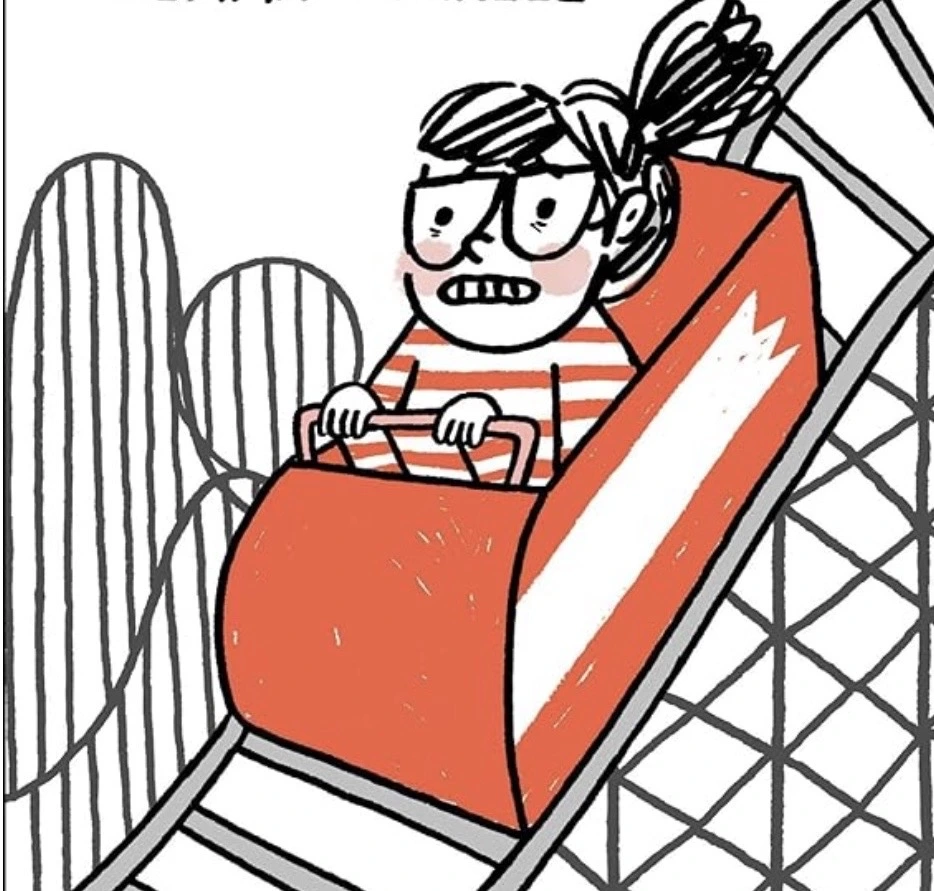
Jennifer Beall Gemma Correll’s graphic memoir describes her experiences with anxiety and depression. She does an impressive job of conveying the effects of mental illness in her self-deprecating humorous style. The memoir depicts Anxietyland, a metaphorical theme park dedicated to her anxiety. The theme park contains such “attractions” as The Worry-Go-Round, The Control Freak Show, The Incredible Shrinking Comfort Zone, and The Parade of Therapists. In the introduction, she describes a weeks-long anxiety attack that eventually landed her in the hospital. She then introduces her anxiety, The Bad Feeling that she first noticed when she was a child. The Bad Feeling constantly made her feel like something bad was going to happen, while also criticizing her and comparing her negatively to other people. She never talked to anyone about The Bad Feeling, which only increased its power over her. She thought she was the only one who felt that way, and she didn’t want anyone to know about it. She got into the habit of telling people she was fine so they would think she was “good” and wouldn’t judge her. She became a people-pleaser, and she developed social anxiety. The memoir alternates between her past and present. The panels representing the past have a red theme, while the panels representing the present have a blue theme. I didn’t realize this at first, and I was confused at the sudden switching back and forth. Once I figured it out, it made much more sense. (I’m sure my daughter, the art major, would have noticed right away!) She writes about the onset of her panic attacks and the ways she tried to prevent them, including going to a lot of trouble to avoid potentially triggering situations. She tried other ways to cope, too, including drinking alcohol and working long hours. She developed agoraphobia and had some episodes of dissociation. She didn’t realize until much later that she also had depression. She describes her experiences with treatment, including inpatient and outpatient hospital programs, and, once she was stabilized, individual therapy. The descriptions of her experiences with medication will probably sound familiar to a lot of people who have taken psychiatric medications. She was skeptical at first, and then found that it made a noticeable difference. Despite the fact that the medication was working, she stopped taking it more than once. Sometimes, she listened to people who told her that she should treat her depression with lifestyle changes or unproven supplements. At other times, she thought she didn’t need it because she was feeling better. She eventually accepted it as an important part of her healing journey. (She mentioned in the introduction to the book that she hates the use of the word “journey” in talking about mental health, but she used it anyway!) Her experiences with individual therapy were mixed. She met with some pretty unusual individual therapists, including a hypnotherapist who had a bunch of clown dolls in her office. She did finally find a therapist who specialized in cognitive behavioral therapy (CBT) and exposure therapy (often called Exposure and Response Prevention therapy, or ERP). Approaches like these are essential to help clients to get panic disorder and agoraphobia under control. I do believe, though, that once she was stabilized, she would have benefited from a “bottom-up” therapy approach to help her get to the root of her negative self-talk. At the end of the book, she imagined telling younger versions of herself the things that would have enabled her to get help sooner. She also told them that asking for help is brave, not a sign of weakness. Are you able to relate to her experience? Would you like to find ways to cope with, and even to heal, your own anxiety? While I am not an ERP (Exposure and Response Prevention) therapist, I do sometimes use CBT with clients, and my “bottom up” approaches to therapy can help you to heal from traumas that can lead to negative self-talk like Gemma Correll’s. If you’d like to know how I might be able to help you with anxiety, fill out the contact form, book a consultation, or call or text me at 410-888-0590.
The Connection Between “Inside Out” and IFS
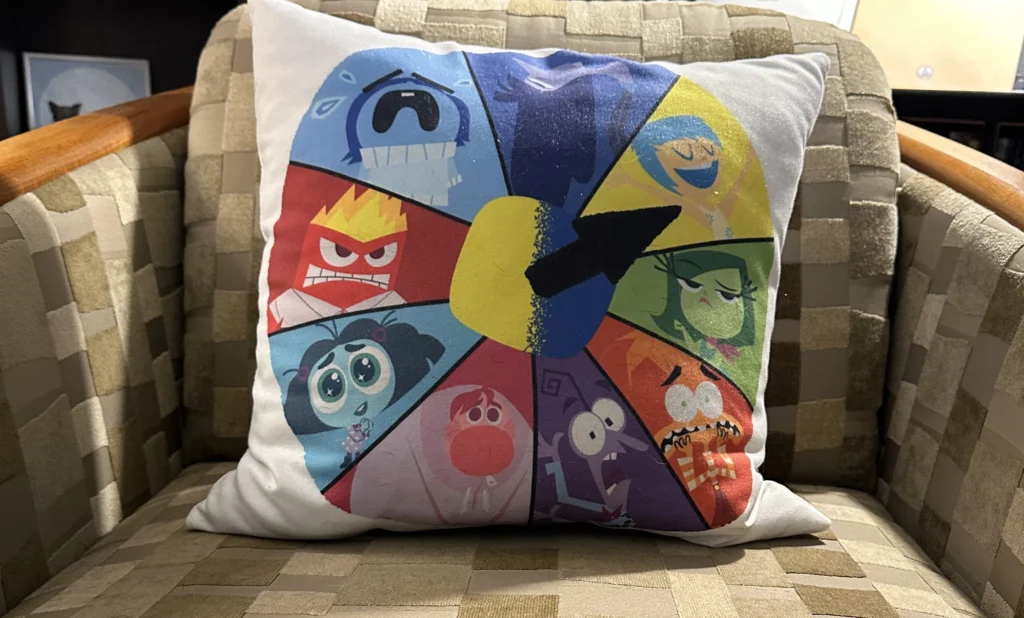
Jennifer Beall (Warning: contains movie spoilers.) The Inside Out movies are great PR for Internal Family Systems (IFS) therapy. They introduce the idea that we all have lots of parts of ourselves, and all of our parts are trying to be helpful, even when they aren’t really qualified to help. In the movies, the parts are all emotions. Both movies show what can happen when one of a person’s parts temporarily takes over the system. IFS calls this being blended with a part. The main character of both Inside Out and Inside Out 2 is a girl named Riley. In the first movie, Riley is eleven years old, and she and her family have just moved from Minnesota to San Francisco. The parts/emotions that are featured are Joy, Sadness, Anger, Fear, and Disgust. Joy believes something that many people do: that emotions other than joy (and its variations) are “negative” emotions. They are certainly emotions that many of us don’t want to feel, and often are discouraged from feeling, but they’re not negative. It’s what you do with the emotions that can be positive or negative. In the first movie, Joy tries to keep Sadness from touching any of Riley’s memories, because she only wants her to have happy memories. There is a struggle, and Joy and Sadness are accidentally pulled out of “Headquarters.” In their absence, Anger, Fear, and Disgust try to keep things running smoothly. Needless to say, it doesn’t go well. For instance, Anger convinces Fear and Disgust that Riley should run away from home and go back to Minnesota so she can be happy. At the end of the movie, Joy and Sadness make it back to Headquarters. Sadness is able to fix a problem with the emotion control console, and Riley goes home to her parents. Joy hands Riley’s memories of Minnesota to Sadness, and Riley begins to cry, telling her parents that she misses Minnesota. They hug her and tell her that they miss it, too. Joy and Sadness work together at the console, and a memory is formed that is both sad and happy. In Inside Out 2, Riley is thirteen years old and about to go to high school. She now has a new part of her mind, a Sense of Self. It seems Joy has forgotten that it’s ok for Riley to have sad memories. She wants Riley’s Sense of Self to have only happy memories, so she creates a mechanism that sends bad memories to the back of Riley’s mind. Riley enters puberty, and four new emotions (Anxiety, Envy, Embarrassment, and Ennui) come on the scene. The new emotions lock the original emotions in a vault and start to form a new Sense of Self that’s centered around Anxiety. The original emotions get out of the vault, and Sadness goes back to Headquarters while Joy, Anger, Fear, and Disgust rescue Riley’s original Sense of Self. Not surprisingly, the Anxiety-led Sense of Self does not work out. Riley ends up having a panic attack in a tryout for the hockey team at her new high school. Joy gets back to Headquarters and reinstates the original Sense of Self, but that doesn’t end the panic attack. Anxiety and Joy realize that neither of them gets to decide who Riley is. A new Sense of Self, containing both happy and sad memories, develops. All of the emotions approve of this third version of Riley’s Self, and Riley calms down. Joy goes back to the console and helps Riley to enjoy the rest of the tryout. The people in the Inside Out movies have less complex systems of parts than actual humans do, but the basic principles are the same: there are no bad parts, and life generally works most smoothly when the parts cooperate with each other and with the person’s Self (which is like a parent to the parts). If you’d like to get to know more about your internal system of parts, fill out the contact form, book a consultation, or call or text me at 410-888-0590.