Jennifer Beall, LCPC, LCADC
Sandtray therapy and IFS (Internal Family Systems) therapy are a natural pairing. My clients and I often use the sandtray to concretize and get to know the parts we’re working with, to make a parts map, and to show the relationships between parts.
All people have many parts. There are exiles (hurt parts, usually very young) and two types of protectors (managers and firefighters). All of these parts interact as if they were part of a (very large) family.
When my clients and I do IFS therapy, we generally start by choosing a part to focus on. If we could just deal with that one part without any other parts showing up, it would be relatively straightforward. That’s not usually how it happens, though. It’s quite common for other parts to jump in during the course of the session.
This can get very confusing, which is why the sandtray comes in handy. Not only can you represent all of your parts in the sandtray so you don’t lose track of them; you can also show their relationships to each other and move them around to show ways in which their relationships change.
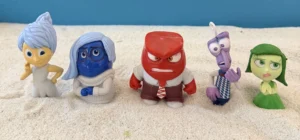
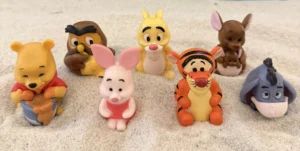
Let’s start with choosing miniatures to represent parts. You might choose miniatures that have clear associations with certain emotions or character traits. For instance, you might choose a character from the Inside Out movies to represent an emotion. You might choose a character from books, movies, or TV, like someone from Star Wars, Harry Potter, or Winnie the Pooh. Or you might decide to select something metaphorical, like a black sheep.
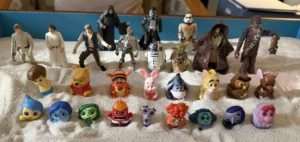
Miniatures don’t have to represent something that’s widely known, though, to have significance. Your unique experiences have created associations that are specific to you. In fact, I often find that selections that have special meaning for the client are the best choices. It’s likely that a part will feel more seen and valued if the miniature chosen to represent them is personal in this way.
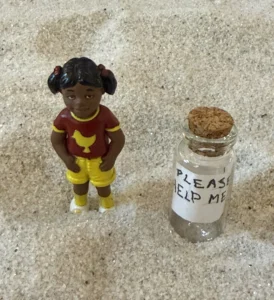
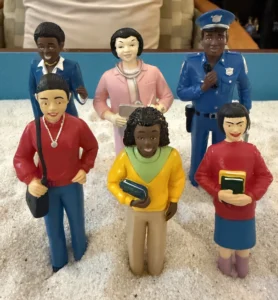
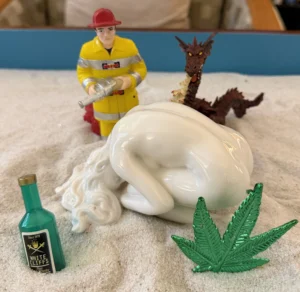
What kinds of miniatures do people generally select to represent exiles, managers, and firefighters? Clients frequently choose young children or babies to represent exiled parts. Managers, which are proactive protectors who try to stop problems before they start, might be represented by miniatures that are associated with responsible or professional roles. A firefighter part, which is a reactive protector who steps in when managers’ efforts aren’t sufficient, could be literally represented by a firefighter. More often, though, clients will choose miniatures that represent firefighter behaviors, like raging at other people, dissociation, or addictive behaviors.
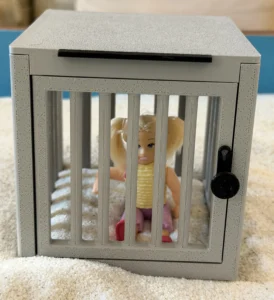
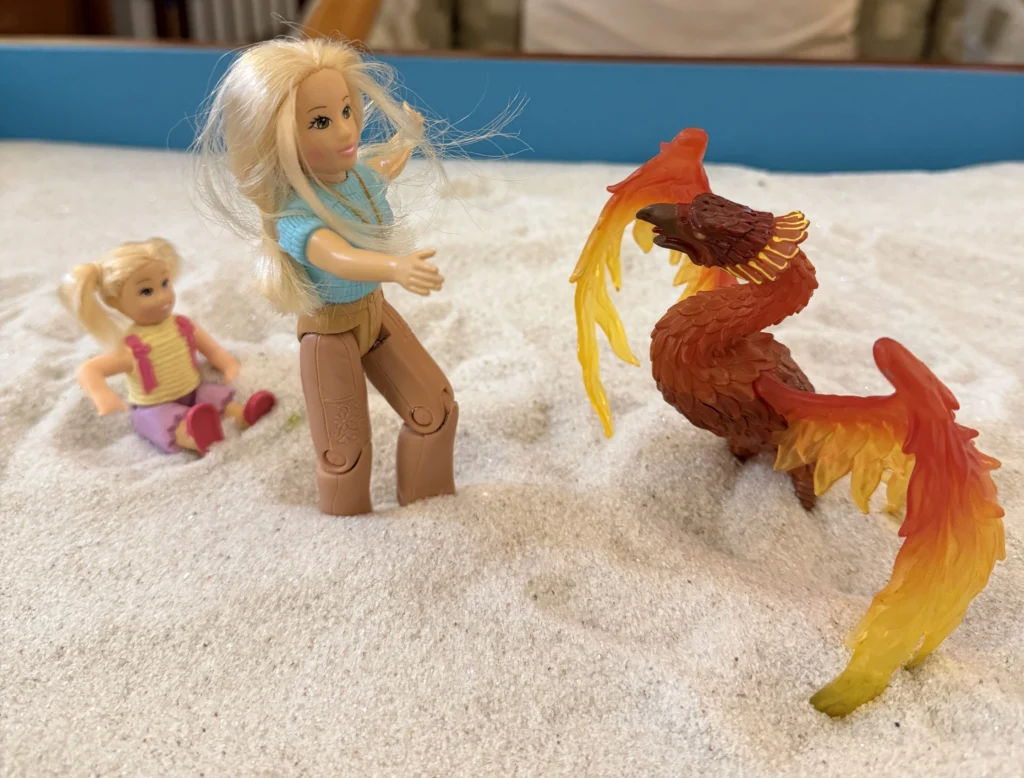
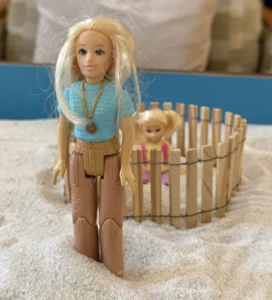
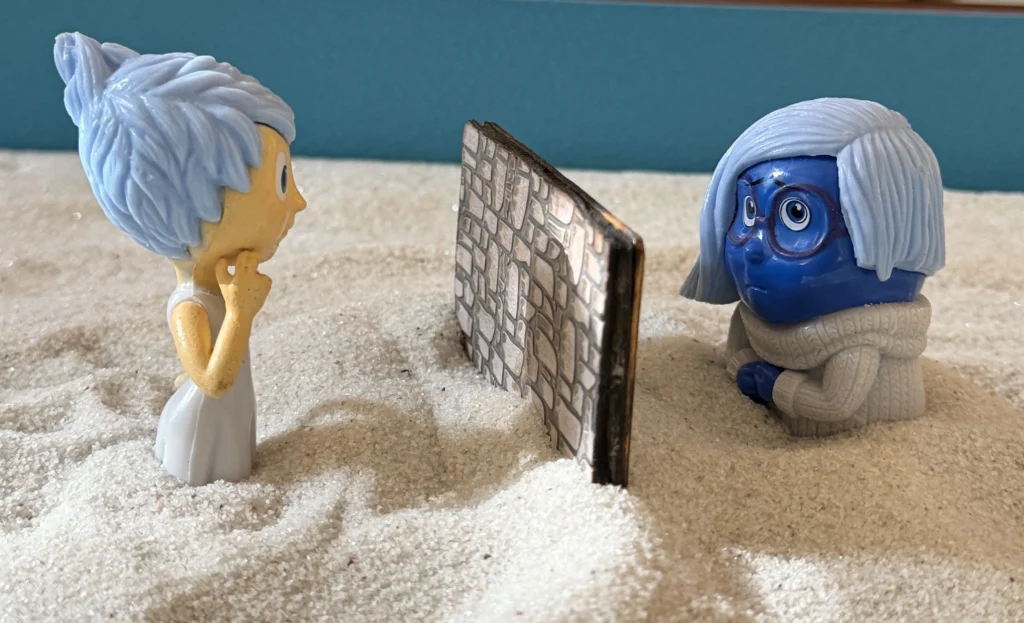
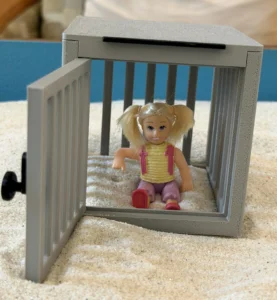
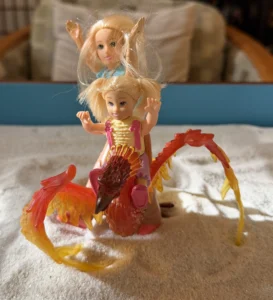
Sandtray work, of course, isn’t just about the identities of individual miniatures; it’s about the placement of the miniatures and their relationships to others. A trapped exile might be in a cage. A protector might stand between an exile and a possible threat, or they might put a barrier around the exile to keep them safe. Polarized parts might physically be set in opposition to each other.
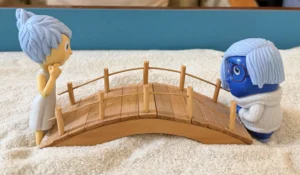
Sandtray scenes don’t have to be static; changes in relationships or circumstances are often represented by rearranging miniatures. The door to the cage might open and free the exile. Something that was originally seen as a threat might turn out not to be a problem after all. And polarized parts can find bridges that help them to connect with each other.
If you and I use the sandtray to work with parts, I’ll encourage you to photograph your sandtrays at the end of each session. That way, you can revisit the parts we worked with in between sessions and, over time, compile an album of photos that make up your parts map. To experience sandtray parts mapping for yourself, fill out a contact form, book a consultation, or call or text me at 410-888-0590.