
Jennifer Beall
For the past several years, my husband has been amassing a collection of bird feeders, many of which are right outside my office. A lot of my clients enjoy looking at the birds, particularly the colorful ones, like the dazzlingly glowing goldfinches and the tiny, jewel-toned hummingbirds. On more than one occasion, my clients and I have been momentarily distracted by an impressive red-bellied woodpecker grabbing a snack!
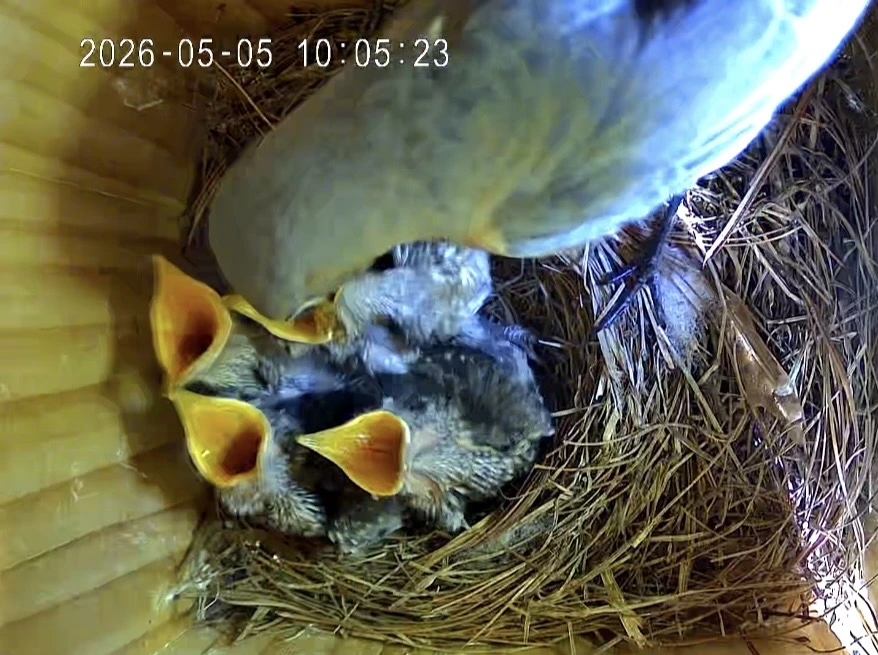
This year, we put up a bluebird house with a camera. There are four baby bluebirds in the nest, and my family and I are enjoying watching them grow. We particularly love seeing them throw open their beaks as soon as their mom or dad shows up with food! My husband has been showing his students the live feed, and I’ve been sharing it with some of my clients, too. It just feels good to watch them.
An article in the Washington Post[i] cites research that suggests that not only seeing or hearing birds outside, but even listening to recordings of birdsong, can make people feel better. While experiencing nature in general is conducive to improved mental health, a study showed that hearing or seeing birds offered additional benefits, separate from the other aspects of nature. The positive effect lasted for hours after the study participants saw or heard the birds.
Another study had participants listen to more or less diverse birdsong or traffic noise through headphones. All of the people who listened to birdsong had a decrease in paranoia and anxiety. Listening to more diverse bird songs (eight different species) also led to a decrease in depressive symptoms. On the other hand, listening to traffic noise (either more or less diverse) made depressive symptoms worse. The study illustrated the benefits of being in nature vs. being in an urban setting.
Spending time in nature and listening to birdsong improves concentration and reduces mental fatigue and stress. It also lowers cortisol levels and blood pressure. Taking walks in nature (rather than in urban settings) also decreases rumination, which is an aspect of depression and some other mental health issues.
And, of course, people who engage in birdwatching tend to get exercise while they’re doing it, which also contributes to positive mental health outcomes.
The article suggests that to get the most out of experiencing birds, it helps to make a point of paying attention to the birds that are around you, and to the joy you get from seeing and hearing them. Learning more about the birds through an app like Merlin Bird ID (which I often use) also helps. You can also join birdwatching groups.
A December 2021 study[ii] showed that spending longer amounts of time outside in daylight increased happiness and decreased the risk of developing Major Depressive Disorder (MDD) as well as decreasing the likelihood of taking antidepressants.
Being in nature makes it easier to practice mindfulness, which helps people with depression to ruminate less.[iii] A June 2019 study[iv] showed that 120 minutes a week (about 17 minutes a day) can have a positive effect on a person’s health and well-being.
If you’re like me, you get messages all day long suggesting ways that you can be healthier. It can be overwhelming, and it can make you feel like you’re never doing enough. Then you might be tempted to just ignore all of it. Even the suggestion to spend 17 minutes a day in nature can sometimes feel like too big of an ask. (My unofficial therapy dog, Finn, would like to point out that if you have a dog, taking him for walks can easily get you that outdoor time!)
It really is not that hard, though, to notice birds, even from inside your house. The fact that recorded birdsong is also beneficial makes the healing power of birds even more accessible. So there’s at least one activity with mental health benefits that isn’t hard to incorporate into your daily life! If you’re experiencing some form of depression and would like help beyond the DIY approaches, though, I’m here for you. You can fill out a contact form, schedule a consultation, or call or text me at 410-888-0590.
[i] https://www.washingtonpost.com/wellness/interactive/2023/birds-song-nature-mental-health-benefits/
[ii] https://pubmed.ncbi.nlm.nih.gov/34488088/
[iii] https://greatergood.berkeley.edu/article/item/can_mindfulness_help_when_youre_depressed
[iv] https://www.nature.com/articles/s41598-019-44097-3